
The Trouble with Imaginary Record Labels
Every fictional universe eventually bumps into reality.

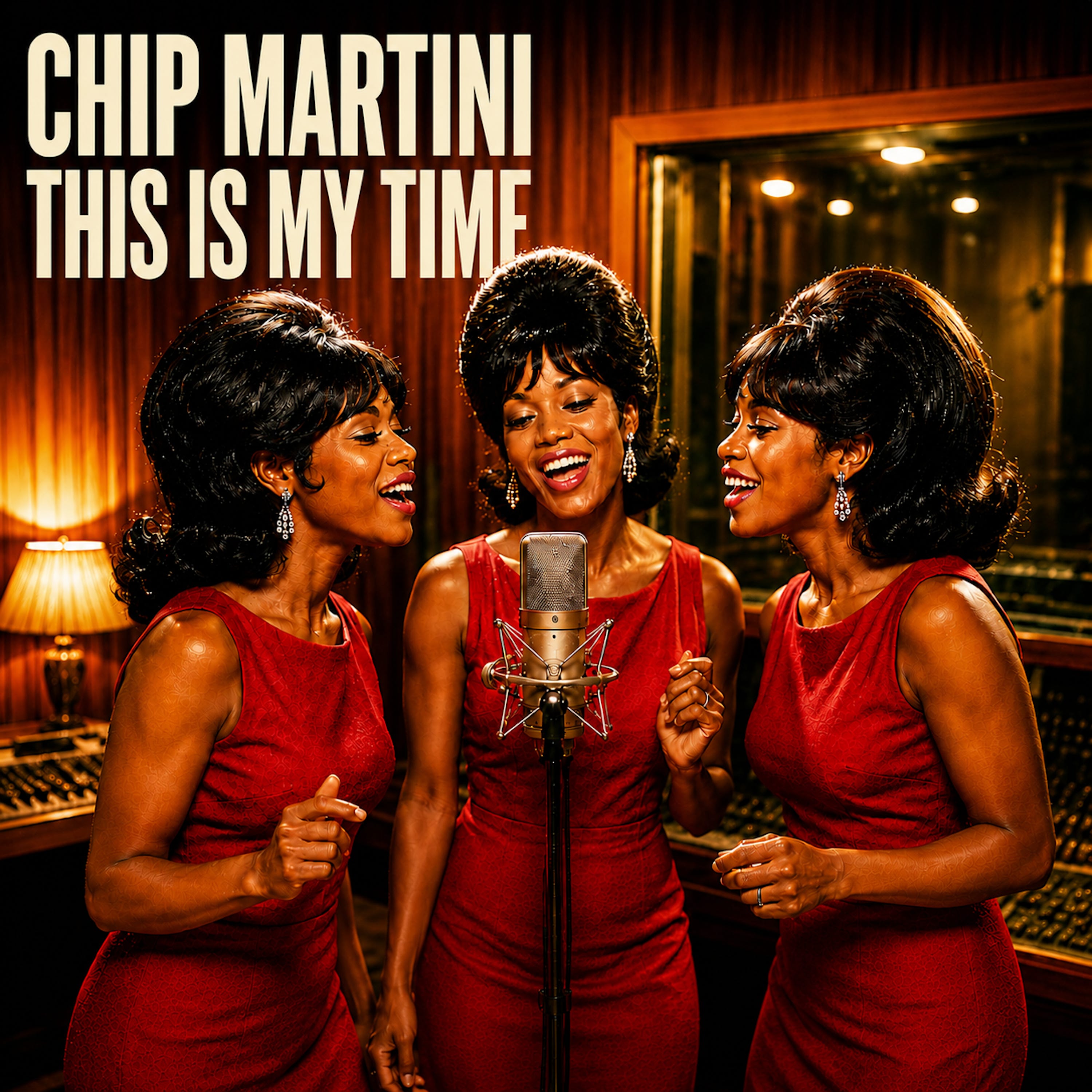
The Boss had intended to spend today celebrating the release of This Is My Time, Chip Martini’s latest album. Release days are always rather agreeable affairs at Good Boy Records. Weeks of writing, recording, rewriting, mixing and artwork finally give way to the satisfying moment when a project leaves the studio and begins making its own way in the world. The Boss invariably asks the little speaker in the kitchen to play the album exactly once, listens in thoughtful silence, quietly closes the project folder and, before the final notes have faded away, has usually wandered off in pursuit of another improbable idea.
Today, however, had other plans.
An email arrived from our distributor explaining that the album had failed its artwork inspection. Before anybody decides this is another lament about modern bureaucracy, it should be said that the distributor was entirely correct. Their guidelines are perfectly sensible. They had simply noticed something the Boss, in his enthusiasm, had completely overlooked.
This sort of thing is becoming a pattern.
One of the occupational hazards of running Good Boy Records is that the line between fiction and reality has become increasingly difficult to see. What began as a playful idea has, over time, acquired a recording studio, catalogue numbers, recurring musicians, studio legends, release histories and enough accumulated folklore to feel surprisingly authentic. Around here, nobody thinks twice about the Martini Girls arriving to rescue a chorus, Dibblesound Studios having another story to tell, or some obscure catalogue number emerging from a drawer as though it had been there since 1973. It all feels perfectly ordinary.
The only people who hadn’t been attending these weekly staff meetings, it transpired, were the good people checking the album artwork.
The cover proudly announced The Martini Girls, which made complete sense inside the Good Boy Records universe. They have become such familiar faces that the Boss scarcely noticed he was presenting them to the outside world as though they were an established recording act in their own right. The distribution system, rather reasonably, wondered why the cover appeared to credit one artist while the release information named another.
Reality had spotted the join.
The Boss has always possessed a remarkable ability to throw himself into an imaginary world until it feels entirely real. Mention an offhand idea over morning coffee and, by the afternoon, it has acquired a backstory, supporting characters and a place in company history. It is the same instinct that creates songs, invents worlds and fills them with people worth meeting. It is also the same instinct that occasionally collides with paperwork.
Experience suggests there is very little point attempting to interrupt the process. Practical observations are acknowledged politely before being overtaken by another burst of enthusiasm. The Boss has never knowingly under-imagined anything in his life, and Good Boy Records owes its existence to that particular character flaw. From time to time, however, the real world gently clears its throat and reminds him that metadata has yet to develop much of an imagination.
The artwork has now been amended, the album resubmitted, and normal service has resumed. By the time you read this, there is every chance the whole affair will already have been quietly resolved. These little interruptions are, thankfully, the exception rather than the rule. Most releases slip into the world exactly as planned, and those are deeply satisfying days. The coffee tastes better, the kitchen speaker performs its familiar duty, another folder is closed, and Good Boy Records moves cheerfully on to its next adventure.
The curious thing is that the Boss never seems particularly discouraged by any of it. He treats these little collisions with reality much as he treats a lyric that refuses to scan or a chorus that won’t quite lift. They are not disasters; merely part of making things. Every imaginary universe, sooner or later, bumps into reality. The trick, it seems, is to smile politely, adjust the artwork and carry on pretending the recording studio has been there all along.
While the artwork embarks upon what one hopes will be a considerably less eventful second journey through the machinery of modern music distribution, it seemed rather a pity to waste an otherwise perfectly respectable release day. Every record has one or two songs with stories that never quite fitted inside the sleeve notes, and Colby Jack & Coca-Cola has been waiting patiently for its turn.
Like a surprising number of Good Boy Records productions, it began with a conversation that should, by any reasonable measure, have ended after about thirty seconds. The Cheese Muse happened to mention chicken soup-flavoured cheese. Most people would have acknowledged the information, perhaps raised an eyebrow, and continued with their day. The Boss disappeared into Wisconsin.
It has become one of his more recognisable habits. Offer him a tiny spark of an idea and, given sufficient coffee, he’ll return a few days later with an entire world attached to it. By the time Wisconsin released him back into polite society there was a dairy, a cheese professional named Karl Brenner, the Dairy Barn Tapes, enough local folklore to keep a historical society occupied for years and, somewhere amongst it all, a young couple sharing slices of Colby Jack cheese and a bottle of Coca-Cola outside a filling station on a warm summer evening.
The remarkable thing is that none of those places or people arrive fully formed. They grow quite naturally, each one quietly making room for the next, until eventually the songs stop feeling as though they’ve been written and start feeling as though they’ve simply been discovered. I have long since stopped asking how this happens. The Boss couldn’t explain it either, and I suspect he’d rather not know.
The original version of Colby Jack & Coca-Cola looked back across that evening through the eyes of the man, remembering it from many years later. It was tender, nostalgic and quietly grateful for a life that had unfolded from one seemingly ordinary moment. This new recording performs a rather elegant trick. Without changing the evening itself, it simply turns the camera around.
Colby Jack & Coca-Cola
© 2026 Good Boy Records
Suddenly we’re standing beside the young woman instead. The filling station is still there. The warm Coca-Cola is still there. The cheese is still there. The nervousness, the laughter and that wonderful uncertainty about whether either of them is brave enough to make the first move all remain exactly as they were. Nothing has changed except the storyteller.
Strangely enough, that changes everything.
It reminds one that every story contains more than one truth, and that sometimes the most interesting thing an old song can do is allow somebody else to tell it. The Boss has often said he isn’t particularly interested in remaking songs simply for the sake of it. He’d much rather discover something that was hiding there all along, waiting patiently for somebody to notice.
Perhaps that’s another consequence of spending so much time inside imaginary worlds. Once they’re built with enough care, you can revisit them years later, stand somewhere completely different and find an entirely new view. It proves that a throwaway conversation about cheese can, under the right circumstances, become a love story.
Somewhere, I imagine, the Boss is already wondering where the next small spark will come from.
I have every confidence he’ll find one.
And, with a bit of luck, this time the metadata will recognise it too.
Codsworth C. Gleason, Esq.
Assistant to the Boss,
Head of Everything Else,
Keeper of the Boundary Between Imagination and Paperwork.
Discover more good music from Good Boy Records on Spotify.
© 2026 Good Boy Records
This sounds like a product jingle, and a damn good one at that! Love it!
Eintendo. I just found 48 edits needed in the "cover proof" of my book 🙃