
The Polk Incident
How a perfectly innocent interview about Elvis Night at Andy’s spiralled into one man’s catastrophic inability to answer a straightforward question.

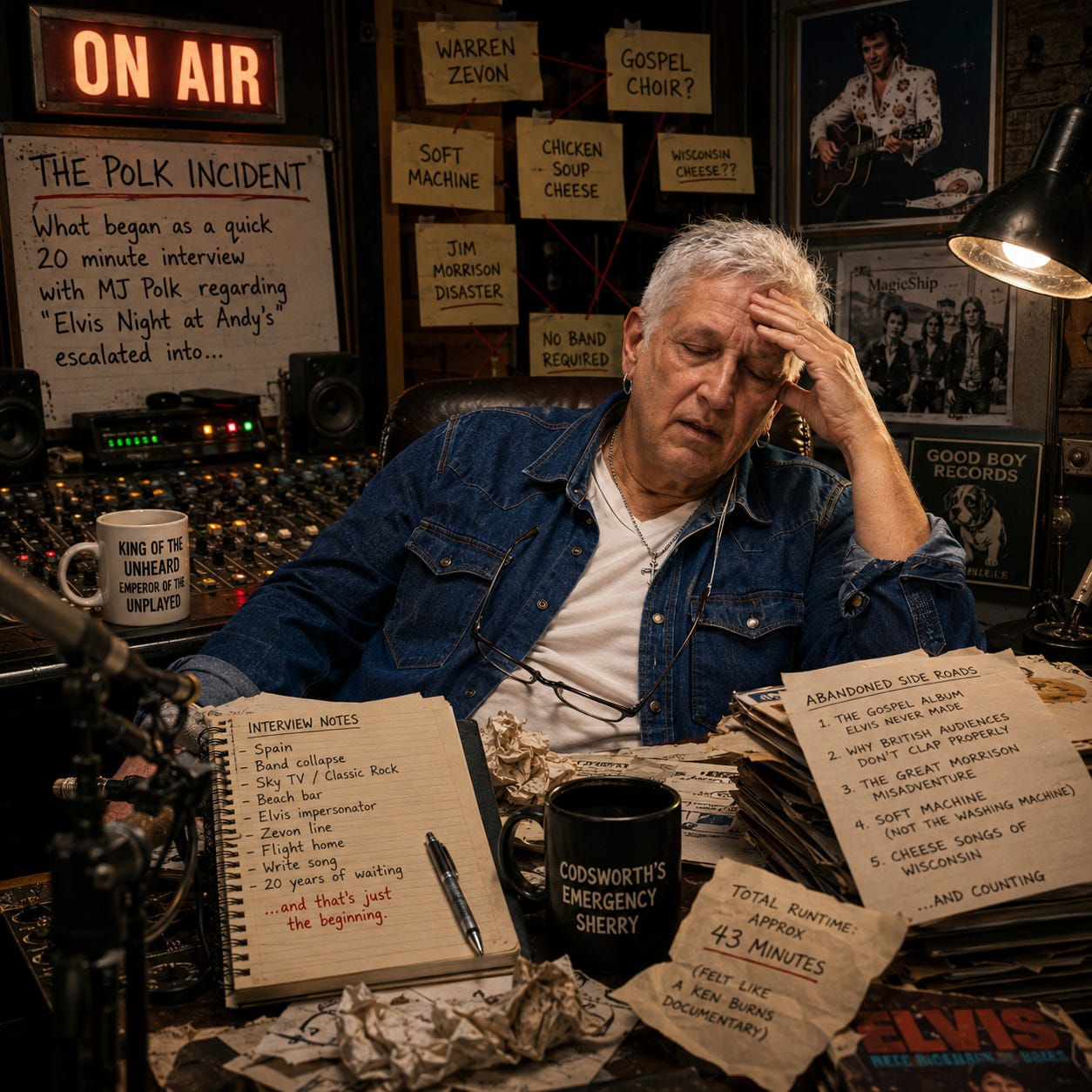
Oh dear, the Boss returned from today’s interview with Mr. Polk looking like a man who had accidentally talked through an international landing slot.
He entered the studio slowly, removed his glasses with visible fatigue, and sat down in the chair opposite the mixing desk with the expression of somebody who had just spent an hour explaining the history of civilisation to a taxi driver who merely asked whether he wanted the airport route or the tunnel.
“I may have gone on a bit,” he said.
Now, for newer readers, it is important to understand that the phrase “gone on a bit” has a very specific meaning inside Good Boy Records. It does not mean “slightly over-excited.” Nor does it imply “mild over-explanation.”
Here, it usually means a casual question has detonated a forty-minute monologue involving at least three unrelated music documentaries, a forgotten nightclub in Europe, and a supporting anecdote about a bloke the Boss once met outside a kebab shop in 1987 who “understood groove properly.”
Today’s catastrophe began harmlessly enough.
Mr. Polk invited the Boss onto a live video chat to discuss Elvis Night at Andy’s, the current Stories From The Jukebox creative writing prompt.
The arrangement was civilised. Respectable, even. A quick twenty-minute conversation between two writers discussing songs, memory, inspiration, and process.
The sort of thing normal people do every day without requiring emergency beverage service or post-event counselling. Unfortunately, Mr. Polk made one critical tactical mistake.
He asked where the song came from.
At this point, the interview stopped being an interview and became a fully mobile narrative weather system.
The original answer lasted approximately twelve seconds before expanding violently outward into Spain, the Boss’s old band MagicShip, Warren Zevon, a missed TV slot on Sky Television, Southern rock blogs, Spanish beach bars, Brazilian carnival dancers, gospel choirs, Soft Machine, AI songwriting, motel managers, Memphis soul, Jim Morrison, and something called chicken soup cheese, which entered the conversation with such confidence one could only assume everybody else already knew what it was.
They did not.
To his enormous credit, Mr. Polk handled the situation magnificently. Several times he attempted to guide the discussion gently back toward the original topic, waiting patiently for what appeared to be a natural pause in proceedings.
This proved impossible because the Boss does not actually speak in pauses.
He speaks in branching river systems.
Every answer opened at least four new exits. By the twenty-minute mark, the conversation had generated enough abandoned side roads to support its own public transport infrastructure.
At one stage, what had begun as a discussion about a song in a Spanish beach bar somehow evolved into a detailed explanation of how a failed attempt to create a godless gospel album eventually led to the invention of Chip Martini, an imaginary chimpanzee recording artist operating out of a fictional Memphis studio with a leopard-print wardrobe and surprisingly strong opinions on backing vocals.
No one involved seemed entirely certain how they had arrived there.
Witnesses later described the moment Warren Zevon entered the discussion as “the point where containment became impossible.”
The true scale of the incident only became clear afterwards during footage review. Analysts confirmed that Mr. Polk had asked approximately six questions during the interview.
The Boss answered one of them.
The remaining five became absorbed into an ever-expanding cinematic universe involving Southern audience etiquette, old Athens music blogs, Elvis theology, memoir writing, gospel harmonies, and a Spanish Elvis impersonator performing Suspicious Minds on a stack of beer crates while the Boss’s increasingly traumatised children questioned his judgment from underneath a beach parasol.
At one point, entirely unprompted, the Boss referred to himself as “the king of the unheard and the emperor of the unplayed.” This statement has now been formally entered into the Good Boy Records archive and will almost certainly appear on novelty merchandise before the end of the fiscal year.
Elsewhere, several members of staff were reportedly forced to abandon routine duties after the interview drifted into an unexpected analysis of British live audiences and why, according to the Boss, they “don’t clap properly anymore.”
One intern has not been seen since the phrase:
“Now this all really started with Warren Zevon…”
And yet, despite the chaos, the wandering roads, the abandoned documentaries, and the conversational debris field left behind by a man physically incapable of brevity, something unexpectedly lovely emerged from the wreckage.
Because underneath all the digressions was the real story.
A songwriter carrying a song around for twenty years.
A failed band.
A holiday in Spain.
A white jumpsuit in a beach bar.
A borrowed pen on the flight home.
A line from Warren Zevon lodged permanently somewhere in the soul.
That was the actual thing sitting underneath all the noise.
The reason the Boss talks about songs the way ancient sailors used to describe storms is because, to him, music is not organised neatly in folders. Everything connects to everything else eventually. Songs become memories. Memories become cities. Cities become albums. Albums become imaginary recording studios in Memphis run by a chimpanzee wearing leopard print while everybody else quietly tries to maintain structural integrity around him.
That is how Good Boy Records happened in the first place. And honestly, thank God Mr. Polk asked the question.
The interview itself may have overrun slightly. Several clocks in the surrounding area reportedly gave up halfway through. But somewhere between the beach bar, the gospel choirs, the dead-end side roads, and the increasingly concerned look in Mr. Polk’s eyes, Elvis Night at Andy’s finally got told the way it was always supposed to be told.
Not cleanly.
Not briefly.
But truthfully.
Mr. Polk survived admirably and is expected to make a full recovery.
Though sources close to the production confirm future interviews may now include scheduled water breaks and a small emergency team trained specifically in conversational extraction techniques.
Codsworth C. Gleason Esq.
Assistant to the Boss,
Head of Everything Else,
Still attempting to determine how Wisconsin cheese entered a discussion about Elvis Presley.
Discover music from Good Boy Records on Spotify
Future interviews are most assuredly still on.
Dude, this is the funniest thing I've ever read! I had to stop five or six times and almost 💀🤣😭
I watched it was a great interview, very entertaining